
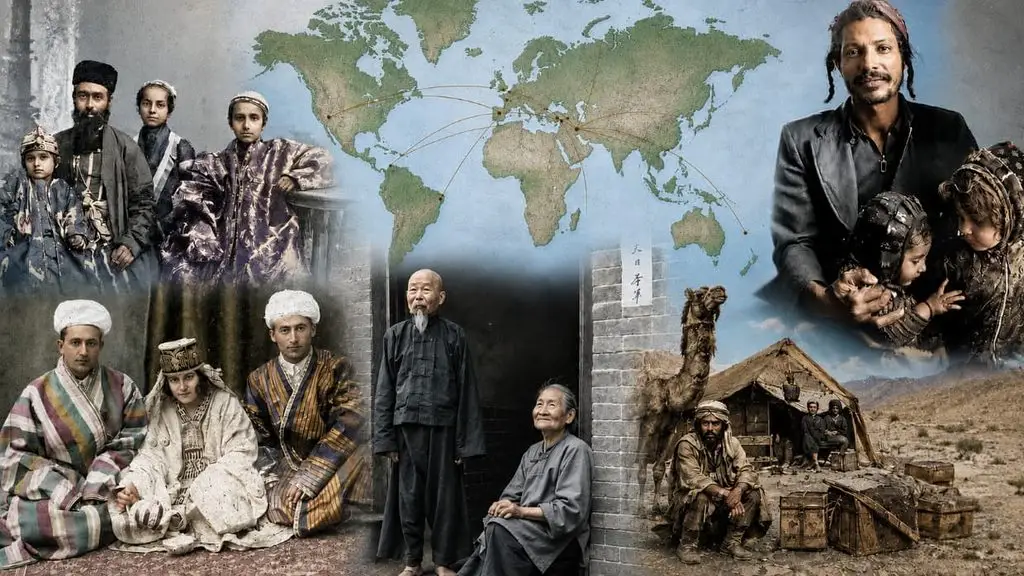
- Kaifeng, China
History: Settled by Persian and Indian Jewish merchants during the Northern Song Dynasty (960–1127 CE).
Community: While assimilation and historical disruptions led to the loss of traditional practice over time, several hundred descendants in Kaifeng still maintain a strong identity and awareness of their Jewish heritage.
- Pathans / Pashtuns (Afghanistan and Pakistan)
History: Oral traditions among certain Pashtun tribes (such as the Afridi and Pashtun clans) suggest ancestral links to the Lost Ten Tribes of Israel.
Community: Though strictly Muslim today, traditional practices such as lighting candles on Friday night, maintaining dietary customs, and wearing garments resembling a tallit reflect historical Jewish cultural remnants.
- Lemba Tribe (Zimbabwe and South Africa)
History: Genetic testing (DNA studies revealing the presence of the Cohen Modal Haplotype) supports the oral history that ancestors migrated from the Middle East.
Community: The group practices male circumcision, refrains from eating pork, separates meat and dairy, and observes Sabbath-like rest practices.
- Igbo Jews (Nigeria)
History: Claiming descent from the tribes of Gad, Zebulun, and Manasseh, the Igbo people of Nigeria have long maintained practices similar to Biblical Judaism.
Community: Thousands actively practice mainstream Rabbinic Judaism today, operating synagogues, studying Hebrew, and keeping kosher.
- Bnei Menashe (India)
History: Located in Northeast India (Mizoram and Manipur), this group identifies as descendants of the tribe of Manasseh.
Community: Over the past few decades, many formally converted to orthodox Rabbinic Judaism, with thousands having made aliyah (immigrated) to Israel.
- Inca Jews / Bnei Moshe (Peru)
History: Founded in Trujillo, Peru, in the late 20th century by Villanueva family members who independently studied the Torah and embraced Judaism.
Community: Under the guidance of Israeli Rabbinical courts, community members underwent formal orthodox conversions, and the vast majority now live in Israel.
- Crypto-Jews / Bnei Anusim (Belmonte, Portugal)
History: Descendants of Jews forced to convert to Catholicism during the Portuguese Inquisition who secretly preserved Jewish rites for over 500 years.
Community: Discovered by the outside world in the early 20th century, the Belmonte community formally returned to Judaism and built a synagogue and Jewish museum.
- San Nicandro (Italy)
History: In the 1930s, a group of Italian Catholic villagers led by Donato Manduzio underwent a spiritual revival through independent Bible reading and embraced Judaism.
Community: Most members formally converted, with many emigrating to Israel after World War II, while a small group remains in Italy maintaining the local synagogue.
- Subbotniks (Russia)
History: Russian peasant families who broke away from the Russian Orthodox Church in the late 18th century to adopt Torah law and Sabbath observance (Subbota meaning Saturday).
Community: Many fully integrated into Rabbinic Judaism over generations, with descendants residing in Russia, Ukraine, and Israel.
- Jewish Community of Uganda (Abayudaya)
History: Founded in 1919 by military leader Semei Kakungulu after he embraced the Old Testament and declared his allegiance to Judaism.
Community: The community practices Conservative and Orthodox Judaism, maintains active synagogues, runs Jewish schools, and is officially recognized by major Jewish movements.
- Amazonian Jews (Iquitos, Peru)
History: Descendants of Moroccan Jewish men who migrated during the late 19th-century Amazon rubber boom and intermarried with local indigenous women.
Community: Many descendants reconnected with their heritage, underwent formal conversions, and immigrated to Israel, while others maintain local communal traditions in Iquitos.
- Suriname (Jodensavanne)
History: Established in the 17th century by Sephardic Jews fleeing the Inquisition, creation of an autonomous Jewish agricultural settlement with sugarcane plantations.
Community: While Jodensavanne is now an archaeological site, Paramaribo retains an active, unified Jewish congregation operating a historic synagogue.
- Cochin Jews (India)
History: One of the oldest Jewish communities in the world, settled along the Malabar Coast of Kerala following the destruction of the First Temple.
Community: The community built historic synagogues, including the Paradesi Synagogue. Most members emigrated to Israel, though historic sites remain preserved.
- Jewish Community of Djerba (Tunisia)
History: Continuous Jewish presence dating back to the destruction of the First Temple, home to the historic El Ghriba Synagogue.
Community: Remains one of the few surviving vibrant Jewish communities in the Arab world, maintaining traditional practices and religious education.
- Jewish Community of Birobidzhan (Russia)
History: Established by Joseph Stalin in 1931 as the Jewish Autonomous Oblast in the Soviet Far East to create a secular Yiddish-speaking socialist alternative to Zionism.
Community: Though the overall Jewish population declined significantly due to emigration, the region retains Yiddish street signs, cultural institutions, and a active synagogue community.